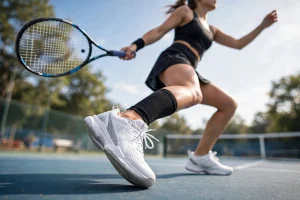
A bunion changes how a tennis shoe has to fit. The joint at the base of your big toe juts outward, the toe itself drifts toward its neighbours, and every push-off, plant and slide presses that bump against the inside of the shoe. A shoe that is merely wide can still hurt if its toe box curves inward, stands too low over the joint, or covers the bump with a rigid guard. What matters is shape.
So this list of the best tennis shoes for bunions was built on toe box shape, not width labels. We ranked measured big-toe width and height, how soft the material over the joint is, and whether the heel holds the foot back so it cannot slide forward and jam the toe. Every pick earned its place on Tennis Warehouse playtests and owner reviews, RunRepeat lab measurements, or Talk Tennis reports from players managing the same bump.
Here are the 10 picks for 2026, from the most complete bunion shoe to a budget option that keeps the joint comfortable. The buyer’s guide at the end explains how to read a toe box yourself, the lacing tricks that unload the forefoot, and when a painful bunion needs a specialist rather than a new shoe.
How We Select These Shoes
We started where bunion players compare notes. Talk Tennis threads follow players through whole seasons in one shoe. Tennis Warehouse playtests and owner reviews supplied the fit reports and complaint patterns, and RunRepeat’s lab supplied the numbers a product page never shows: toe box width, toe box height, and shock absorption.
Three filters did the cutting. Shape at the big toe first: width and height where the joint sits, and a toe line that does not steer the toe inward. What covers the bump second: soft mesh passes, a rigid medial guard gets flagged in that shoe’s review. Complaint honesty third: when owners kept reporting the same failure, the shoe came off the list. One of the most cushioned shoes we measured was cut because its toe box measured narrow. That is the standard behind this guide to the best tennis shoes for bunions.
Top Picks at a Glance
Short on time? Here is the whole lineup on one screen.
| Shoe | Best For | Price |
|---|---|---|
| Wilson Rush Pro Ace | Best Overall | Check Price on Amazon |
| adidas Solematch Control 2 | Best Cushioning | Check Price on Amazon |
| K-Swiss Hypercourt Express 2 | Best Wide Toe Box | Check Price on Amazon |
| Babolat SFX EVO AC | Best Straight Toe Line | Check Price on Amazon |
| New Balance Fresh Foam X 1007 | Best Extra-Wide Fit | Check Price on Amazon |
| Prince T22.5 | Most Durable | Check Price on Amazon |
| Mizuno Wave Enforce Tour 2 | Best Heel Cushioning | Check Price on Amazon |
| New Balance FuelCell 996 v6 | Best Lightweight | Check Price on Amazon |
| HEAD Sprint Pro 4.0 Wide | Best Speed | Check Price on Amazon |
| adidas Gamecourt 3 | Best Budget | Check Price on Amazon |
1. Wilson Rush Pro Ace – Best Overall Tennis Shoes for Bunions

Start with the measurements, because this shoe wins on shape. RunRepeat put its big-toe width at 72.7 mm, one of the widest they have tested, and the box stands 27.6 mm tall, so the joint gets room upward as well as sideways. The Sensifeel upper is soft and minimally layered, nothing rigid sits on the bump, and cushioning is balanced at 95 SA in the heel and 58 in the forefoot.
Two honest limits. Tennis Warehouse notes the box narrows at the tip, so check your length, and there is no extra-wide version, because the Ace last is already Wilson’s wide fit. A secure midfoot stops the foot sliding forward into the box. For most players, this is the most complete of the best tennis shoes for bunions.

Pros
- One of the widest measured big-toe boxes (72.7 mm)
- Tall toe box gives the joint vertical room
- Soft, lightly layered upper over the bump
Cons
- Toe box narrows at the very tip
- Forefoot cushioning is mid-pack (58 SA)
- No separate 2E version
2. adidas Solematch Control 2 – Best Cushioning Tennis Shoes for Bunions

The lab’s widest forefoot in this set belongs to the Solematch Control 2: 96.3 mm at the widest point and 73.0 mm at the big toe, in a rounded shape that lets the toes spread instead of steering them inward. Underneath sits a full BOOST midsole, the plushest ride here, and Tennis Warehouse buyers keep singling out the wider toe box.
The community evidence is just as direct. On Talk Tennis, a player with a bunion traced his pain to sizing down and jamming the joint forward; in this shoe’s first version, at his proper size, the pain stopped. Trade-offs: weight (15.4 ounces, the heaviest here), toe box height a touch low, and a less grippy outsole. As pure comfort, it stands with the best tennis shoes for bunions.

Pros
- Widest measured forefoot here (96.3 mm)
- Rounded toe shape lets toes spread
- Plush BOOST cushioning
Cons
- Heaviest pick on the list (15.4 oz)
- Toe box height slightly below average
- Outsole grip is below the field average
3. K-Swiss Hypercourt Express 2 – Best Wide Toe Box Tennis Shoes for Bunions

Ranked by the widest single measurement, this is the shoe: 96.0 mm across the forefoot in RunRepeat’s gel test, 71.3 mm at the big toe, and balanced cushioning at 100 SA in the heel and 70 in the forefoot. Tennis Warehouse rates the fit slightly wide, the model is also sold in a true 2E, and a K-Swiss customer credits the wide toe box with keeping their bunions comfortable.
Now the weakness, plainly. Owners report the tread wearing smooth in about a month of regular play, with no outsole guarantee, and the mesh forefoot sits between DuraWrap overlays, so it is roomy rather than fully soft over the bump. Among the best tennis shoes for bunions on measured width, it asks you to budget for faster wear.

Pros
- 96.0 mm forefoot, the widest measured
- Also sold in a true 2E wide version
- Balanced cushioning (100 heel / 70 forefoot SA)
Cons
- Repeated reports of tread gone in about a month
- No outsole durability guarantee
- Overlays flank the forefoot mesh
4. Babolat SFX EVO AC – Best Straight Toe Line Tennis Shoes for Bunions

Babolat builds the SFX line on a last about 6% wider than standard, and the EVO keeps the family’s soft, breathable mesh over the toes. What bunion players praise most is the toe line: the big-toe side runs fairly straight instead of curving inward, so the toe sits in its natural line rather than being steered toward the others.
Two disclosures belong here. The medial toe box carries Babolat’s Pro Shield, a heavy rubber guard that can sit close to the bump, so check where it lands on your foot. And no lab has published measurements for this shoe, so among the best tennis shoes for bunions its place rests on the wider last and owner reports, not millimetres.

Pros
- Built on a roughly 6% wider last
- Fairly straight big-toe line
- Soft, breathable mesh forefoot
Cons
- Rubber medial guard may sit near the bump
- No lab measurements published
- Midfoot still fits fairly standard
5. New Balance Fresh Foam X 1007 – Best Extra-Wide Fit Tennis Shoes for Bunions

For a bunion on a genuinely wide foot, nothing else on this page competes. The 1007 is sold in true 2E and 4E widths, the link here leads to the extra-wide version, and Tennis Warehouse rates even the standard fit a generous medium. The mesh over the toes is soft, and Fresh Foam X gives the plushest, most forgiving step of any New Balance court shoe.
The known weakness, stated the way owners report it: the upper can start tearing at around three to five months, and no lab review exists. If your feet are standard width and your bunion is mild, the structured picks above serve you longer. If you need real width, this is the honest trade, and the best tennis shoes for bunions for wide feet start here.

Pros
- True 2E and 4E widths, the only 4E here
- Soft mesh over the toes
- Plush Fresh Foam X ride
Cons
- Owner reports of upper tearing at 3 to 5 months
- No lab measurements available
- Soft ride is less stable for aggressive movers
6. Prince T22.5 – Most Durable Tennis Shoes for Bunions

The T22.5 is here on a durability record few shoes match. Men’s reviewers at Tennis Warehouse describe outsoles barely worn after weeks of play, one calls it the first shoe where his serving toe did not wear through early, and the shoe carries a 6-month outsole durability guarantee. A ShockEraser heel insert and SoftSpring forefoot insert handle landings, and owners describe more forefoot room than the label suggests.
Its bunion limits are equally clear. The width rates medium, the layered upper is reported stiff and needs break-in, and sizing runs small, so go up half a size. Among the best tennis shoes for bunions, this is the pick for the player who destroys shoes and has a mild bump, not the softest home for a sore one.

Pros
- 6-month outsole durability guarantee
- Owners report exceptional outsole life
- ShockEraser heel and SoftSpring forefoot inserts
Cons
- Stiff upper, break-in required
- Runs small, size up half a size
- Standard width only
7. Mizuno Wave Enforce Tour 2 – Best Heel Cushioning Tennis Shoes for Bunions

Heel strikers start here. RunRepeat measured its heel shock absorption at 105 SA, the best in this set, and Tennis Warehouse playtesters reported a comfortable fit with no pinching. The broad, stable platform suits bigger players who load the shoe hard.
The tension in the evidence deserves airing. The same lab measured the toe box below average at 67.5 mm and forefoot cushioning at only 58 SA, so the room playtesters feel is not concentrated at the big toe. Mild bunions and heel-first landings suit it well; a large, sore bump will be happier higher up this list of the best tennis shoes for bunions.

Pros
- Best heel cushioning here (105 SA)
- Playtesters reported room and no pinching
- Broad, stable platform
Cons
- Lab toe box measured below average (67.5 mm)
- Forefoot cushioning only 58 SA
- Room is not focused at the big toe
8. New Balance FuelCell 996 v6 – Best Lightweight Tennis Shoes for Bunions

The widest big-toe measurement in this set belongs to its lightest shoe: 74.3 mm where the joint sits, under a porous net mesh that flexes over the bump instead of arguing with it. The midfoot is no noodle either; the lab measured it the stiffest here in torsion, so the shoe stays supportive while it stays quick.
Know its limits. The toe guard scored the lab’s lowest durability mark, so toe draggers should look elsewhere, and one wide-footed buyer found the 2E narrower overall than the 1007: the width here lives at the toe, not in total volume. It is also the outgoing generation. As a lightweight entry among the best tennis shoes for bunions, nothing matches its toe room per ounce.

Pros
- Widest measured big-toe width (74.3 mm)
- Soft, porous mesh over the forefoot
- Light, with the stiffest midfoot here
Cons
- Toe guard durability scored 1 out of 5
- Less total volume than the 1007
- Outgoing generation (v6)
9. HEAD Sprint Pro 4.0 Wide – Best Speed Tennis Shoes for Bunions

Most speed shoes are bunion traps, narrow and rigid. This one is built on a true wide last: Tennis Warehouse rates this version’s width Wide, a separate fit from the standard 4.0, and the forefoot is a lightweight breathable mesh. Buyers on the wide listing say they chose it for the toe box, and at 13.5 ounces it stays properly quick.
The compromises are cushioning and wear. The ride is firm and minimal, the upper shows wear fast, HEAD’s Drift Defense reinforcement sits on the medial side with its stiffness over the bump untested, and one wide-listing buyer reported pain under the ball of the foot. Fast and wide among the best tennis shoes for bunions, yes; plush, no.

Pros
- True wide last, not just a size up
- Soft, breathable mesh forefoot
- Light and fast at 13.5 oz
Cons
- Minimal, firm cushioning
- Upper wears quickly
- Medial reinforcement stiffness untested
10. adidas Gamecourt 3 – Best Budget Tennis Shoes for Bunions

The Gamecourt 3 earns the budget slot the simple way: a soft mesh upper that flexes over the bump instead of fighting it, a forgiving fit owners buy for comfort, and none of the rigid cages that make cheaper shoes miserable for bunions. It is the easiest-wearing shoe on this page for social and club tennis.
Honesty about the evidence: no lab review and no Tennis Warehouse playtest exists for this version, so its claims stay modest. The fit is standard medium with no wide version, and the cushioning is basic. For a mild bump, it closes this list of the best tennis shoes for bunions without punishing the joint; a severe one deserves the measured picks above.

Pros
- Soft, flexible mesh upper
- Forgiving, comfort-first fit
- The budget pick of this list
Cons
- No wide version available
- Basic cushioning and support
- No lab or playtest data for v3
Buyer’s Guide: Best Tennis Shoes for Bunions
The reviews above are the shortlist. This guide covers what decides whether any shoe will work over a bunion: what the bump actually is, why toe box shape beats the width label, the lacing tricks that unload the joint, and where a shoe stops being the answer.
What a Bunion Does to Your Tennis Game

A bunion, hallux valgus in the clinic, is a joint problem, not a skin problem. The first metatarsal drifts outward, the big toe drifts inward toward the second toe, and the joint between them juts out as the bump you see. Tennis loads exactly that joint: you push off it on every serve and sprint, and plant on it when you change direction. A shoe that presses the bump squeezes an already irritated joint: fine for twenty minutes, then a hot, aching forefoot for the rest of the session. Shoes cannot move the joint back. What they can do is stop pressing it, and that is most of the battle.
Toe Box Shape Beats the Width Label

The width printed on the box is the weakest clue on this page. A wide shoe whose toe box tapers to a point will still steer your big toe inward and lean on the bump, while a standard-width shoe with a straight big-toe line and a soft forefoot can be painless. Judge three things instead. The toe line: follow the inside edge; you want it fairly straight, not curving away from the big toe. The height: the joint needs vertical room, because a low box presses down on the bump even in a wide shoe. And the covering: stretch mesh gives when the joint swells mid-match, while a rigid guard parked on that spot is the most common reason a wide-labelled shoe still hurts. Measure your foot standing, late in the day, and compare its widest point with the shoe’s, not with the size label.
Fit Checks and Lacing Tricks for Bunions
Fit the shoe to the bump, not to the chart. Leave a thumb’s width ahead of your longest toe, because a foot that slides forward jams the toe and pushes the joint outward; the heel lock matters as much as the toe room. Never size down for a snug fit. Two lacing changes help immediately: skip the bottom eyelet so lacing starts above the forefoot, and use the extra top eyelet for a runner’s loop so the heel stays back. Silicone toe caps take the friction off the skin over the joint, and icing it after a hard session settles the flare.
Insoles, Orthotics and When to See a Specialist
Most picks here have removable insoles, and a structured aftermarket insole is the cheapest upgrade in this guide: it holds the midfoot so the forefoot spreads less under load. Custom orthotics are the next step when pain persists in good shoes. Know the line where footwear stops being the answer: pain at rest, swelling that does not settle overnight, numbness, or a toe crossing over its neighbour means a podiatrist, not a bigger shoe. Shoes manage pressure; they do not correct the joint.
Frequently Asked Questions
Can the right tennis shoes fix a bunion?
No, and be suspicious of any product that says otherwise. A bunion is the joint drifting out of line, and no shoe moves bone back. What the right shoe does is stop pressing the joint, which for most players is the difference between pain that ends the session and a bump they can play on for years.
Should I buy a wide shoe or just size up?
Buy the width first. Sizing up adds length everywhere, including ahead of the toes, so the foot slides forward and jams the joint against the front, the exact mechanism bunion players on Talk Tennis blame for their worst pain. A true wide, or a standard shoe with a straight, tall toe box like the picks at the top of this list, gives room where the bump actually is.
Do I need orthotics if I have bunions?
Not automatically. Start with the shoe and a structured aftermarket insole; that settles most recreational players. Orthotics earn their place when pain persists, or when one foot is clearly worse than the other. If you get them, bring the shoe along, because they take up room the toe box has to spare.
Can I keep playing tennis with a bunion?
Most players can, for a long time, provided the footwear stops loading the joint and the pain stays in the mild, settles-overnight category. Manage the load: room at the toe, a locked heel, lacing that skips the forefoot, ice after hard sessions. Pain that lingers into the next day, swelling that stays, or a toe starting to overlap are the signals to get the joint looked at.
How often should bunion players replace their tennis shoes?
Earlier than you think, because the failure is invisible. As the midsole packs down and the upper sags, the foot moves more inside the shoe and the bump takes more friction, often before the outsole looks worn. For regular players that point arrives around 45 to 60 hours of court time. If a once-comfortable pair starts leaving the joint hot, the shoe has changed, not your foot.
Match the shoe to your bump, not to a label. Start with the Rush Pro Ace for the most complete shape, the 1007 if your feet are wide as well as bunioned, and the Express 2 if measured width is what you trust. A good pair quietly does the one job that matters: it leaves the joint alone. Related guides: best tennis shoes for wide feet, best tennis shoes for flat feet and best tennis shoes for plantar fasciitis.