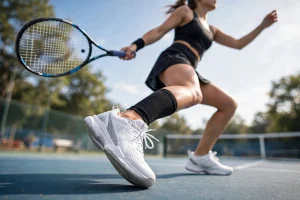
Hard courts don’t forgive. Every step lands on concrete or asphalt sealed under acrylic, and the surface gives back nothing. Your shoes take the full beating, and so do your knees.
That’s why picking the right shoe for hard courts matters more than for any other surface. The wrong pair wears through in weeks and leaves you sore. The right pair lasts months and keeps you moving well into the third set.
We didn’t test these on court ourselves, and we won’t pretend we did. Instead, we spent over 100 hours reading what actual hard-court players say across Tennis Warehouse playtests, Talk Tennis forums, Reddit, and YouTube reviews. We looked for durability on abrasive surfaces, cushioning that holds up, and honest complaints, not marketing claims.
Here are the 10 best tennis shoes for hard courts in 2026.
How We Pick the Best Tennis Shoes for Hard Courts
We don’t guess. Every shoe on this list earned its spot through hours of research across the places where real tennis players talk honestly about their gear.
We dug through Talk Tennis forum threads where durability-obsessed players log exactly how many hours they get out of each outsole. We read Tennis Warehouse playtest reviews and customer feedback. We compared notes from Tennisnerd, Tennis.com, and retailer reviews to spot patterns, not outliers.
For hard courts specifically, we weighted three things above everything else: outsole durability (herringbone pattern in a dense rubber compound, because that’s what survives concrete), cushioning (hard courts don’t absorb shock, so your shoes must), and lateral stability (for the hard stops and direction changes that define hard-court tennis).
We also excluded anything with a pattern of serious complaints. If players consistently reported the same problem, the shoe didn’t make the list, no matter how popular the brand.
Top Picks at a Glance
| Shoe | Best For | Outsole | Price |
|---|---|---|---|
| ASICS Gel-Resolution X | Best Overall | AHAR herringbone | Check Price |
| adidas Barricade 13 | Most Durable | Adiwear herringbone | Check Price |
| ASICS Court FF 3 | Best Premium Cushioning | AHAR herringbone | Check Price |
| New Balance Fresh Foam X 1007 | Best Comfort | Ndurance herringbone | Check Price |
| Mizuno Wave Enforce Tour 2 | Best Stability | DuRubber herringbone | Check Price |
| Wilson Rush Pro 4.5 | Best Arch Support | Duralast herringbone | Check Price |
| adidas Ubersonic 5 | Best Lightweight | Adiwear herringbone | Check Price |
| ASICS Gel-Challenger 15 | Best Value | AHARPLUS herringbone | Check Price |
| K-Swiss Ultrashot 3 | Best for Wide Feet | Aösta herringbone | Check Price |
| ASICS Gel-Dedicate 8 | Best Budget | AHAR herringbone | Check Price |
1. ASICS Gel-Resolution X – Best Overall Hard Court Tennis Shoes

The Gel-Resolution X is the shoe most hard-court regulars end up in. It’s built like a tank, with ASICS’ AHAR high-abrasion rubber in a herringbone pattern that holds up on concrete. The Dynawall lateral support keeps you stable on hard stops, and there’s enough GEL cushioning to take the edge off.
It’s not perfect. This is actually the most divisive shoe on our list. A 500+ post Talk Tennis thread has Gel-Resolution 9 loyalists calling the X a step back. It’s heavier than the 9, the midfoot runs wider, and the high collar bothers some players. A few report heel slippage and trouble getting the lacing right. One Dick’s reviewer gave it 2 out of 5, saying their feet hurt within minutes.
But here’s the other side. Forum testing found it among the most cushioned shoes you can buy right now. Coaches and higher-level players still pick it for all-day comfort on hard courts. If you want maximum support and don’t mind the weight, it’s hard to beat.
Pros:
- Excellent lateral stability for aggressive movers
- AHAR outsole holds up well on abrasive hard courts
- Among the most cushioned options available
Cons:
- Heavier than the previous Gel-Resolution 9
- High collar can feel restrictive
- Some players report heel slippage
2. adidas Barricade 13 – Most Durable Hard Court Tennis Shoes

If durability is your top concern, start here. The Barricade line has been the hard-court workhorse for years, and the 13 keeps that reputation. The Adiwear outsole in a herringbone pattern is built for concrete. Talk Tennis durability hounds report 36 to 40 hours of hard-court play per pair, and one daily player stretches a pair to 10 months.
It rates 4.7 out of 5 on Dick’s, with 93% of reviewers recommending it. A long-time wearer on Zappos says it’s comfortable out of the box, with great support and better breathability than older Barricades.
The knocks are familiar Barricade issues. The midfoot runs narrow, and the sidewall can feel claw-like on wider feet. Some players get heel slippage. A few Talk Tennis regulars feel the 13’s soles are softer and thinner than the classic Barricades (the 2, 5, 6, and 12), so if you loved those tanks, this one might feel a touch less bombproof.
Pros:
- Outstanding outsole durability on hard courts
- Comfortable with no break-in needed
- Strong lateral support
Cons:
- Narrow midfoot can pinch wider feet
- Some heel slippage reported
- Soles feel softer than classic Barricade models
3. ASICS Court FF 3 – Best Premium Cushioning for Hard Courts

The Court FF 3 is ASICS’ premium hard-court shoe, and it shows in the cushioning. Tennis Pursuits testing found top-tier abrasion resistance and heel impact protection, explicitly calling it strong on hard courts. The 3-piece sole (which Djokovic helped develop) gives a unique ride.
Tennis Warehouse customers give it 3.9 out of 5. Players like the snug ankle hold, the lack of break-in, and the lateral support. It feels locked in from the first wear.
The main complaint is heel lift for narrow-heeled players. If your heel is narrow, you might not be able to fix it with lacing. It’s also a premium shoe in every sense, including the fit. Try it before committing if you can.
Pros:
- Top-tier cushioning and heel impact protection
- Excellent abrasion resistance on hard courts
- No break-in period
Cons:
- Narrow heels may experience unfixable heel lift
- Premium positioning
4. New Balance Fresh Foam X 1007 – Best Comfort for Hard Courts

The 1007 is the comfort pick. Fresh Foam X midsole, roomy toe box, and no break-in. Zappos reviewers like the fit right out of the box. A Road Runner Sports fit expert notes the Fresh Foam X holds up in long matches, the herringbone grips hard courts well, and the toe guard adds durability.
It carries a 6-month outsole warranty, which tells you New Balance stands behind it on hard courts.
One red flag worth knowing. A detailed review from a 4E wearer documents both side mesh walls tearing after about 45 days, plus fast tread wear. New Balance honored the warranty with a gift card, so the support is there, but it’s something to watch if you’re hard on shoes.
Pros:
- Roomy toe box, comfortable immediately
- Fresh Foam X cushioning holds up in long matches
- 6-month outsole warranty
Cons:
- Some reports of mesh tearing with heavy use
- Tread can wear faster than expected for some players
5. Mizuno Wave Enforce Tour 2 – Best Stability on Hard Courts

Mizuno doesn’t get enough love in tennis, but the Wave Enforce Tour 2 deserves a look. Tennis Warehouse playtesters scored it 8.4 to 8.8 out of 10, praising cushioning, comfort, and traction. It comes with a 6-month outsole guarantee (DuRubber compound).
Customers give it 4.2 out of 5. It’s comfortable out of the box, has good arch support, and the outsole holds up. On Talk Tennis durability rankings, it lands mid-pack. About 6 weeks to 2 months for a daily 2-hour player, which is respectable.
Complaints include a very short tongue, less plush feel than the first generation, and a heavy, high ride that some players don’t love. It’s a stability shoe, so it won’t feel nimble.
Pros:
- Strong stability and lateral support
- Good arch support out of the box
- 6-month outsole guarantee
Cons:
- Very short tongue bothers some players
- Feels heavy and high off the ground
- Less plush than the previous generation
6. Wilson Rush Pro 4.5 – Best Arch Support for Hard Courts

The Rush Pro 4.5 is a solid all-rounder with good cushioning even for heavier players, according to Tennisnerd. It has Wilson’s Duralast abrasion-resistant outsole, a TPU stability plate, and an upgraded drag pad. There’s also a 6-month outsole guarantee.
Tennis.com highlights the Duralast compound and stability features. A 4.0 player on Talk Tennis found it stable with no issues.
The main concern is heel wear. A 62-year-old player wore through the heel in about 8 weeks on medium hard courts, though he used the warranty. Narrow heels might also get some slippage. It’s worth checking the fit carefully.
Pros:
- Good cushioning for heavier players
- Duralast outsole with 6-month guarantee
- Stable with TPU plate
Cons:
- Heel can wear through faster than expected
- Narrow heels may slip
7. adidas Ubersonic 5 – Best Lightweight Hard Court Shoes

The Ubersonic 5 is for players who want speed. Tennis Warehouse playtesters gave it 8.3 out of 10, calling it speedy, stable, and well-ventilated. Jonas Eriksson from Tennisnerd describes it as stable and explosive, with confident sliding.
Talk Tennis players note the rubber is harder than the Ubersonic 4, which means longer life on indoor hard courts. Heel lockdown is better too.
But it’s divisive. TW customers are split at 3.2 out of 5. Some love the comfort and lockdown. Others call it bulky and stiff compared to the beloved Ubersonic 4, with a tight, pointy toebox that runs small. Durability “could be better” per TW playtesters. One player went bald at the ball of the foot after 5 months. And it needs a break-in period, which speed shoes shouldn’t always require.
Pros:
- Fast, responsive feel for aggressive movers
- Harder rubber than previous version lasts longer
- Good heel lockdown
Cons:
- Runs small with a tight toebox
- Durability could be better
- Needs break-in
8. ASICS Gel-Challenger 15 – Best Value Hard Court Shoes

The Gel-Challenger 15 might be the smartest buy on this list. A multi-brand tester on Talk Tennis picked it after 4 hours of trying different shoes. Stable, comfortable, nimble, not clunky. A varsity player’s parent says it’s as good as the Gel-Resolution 9 and more comfortable, echoing YouTube chatter that calls it “basically the Gel-Res 9.”
The specs back it up. Wingwall lateral support, GEL in the heel, AHARPLUS herringbone outsole. It runs cool, which matters on hot hard courts.
The main knock is weight. It’s gained some compared to older Challengers. But for the performance you get, most players won’t mind.
Pros:
- Excellent value for the performance
- Stable and nimble, not clunky
- Runs cool on hot courts
Cons:
- Heavier than previous Challenger models
9. K-Swiss Ultrashot 3 – Best Hard Court Shoes for Wide Feet

Wide-footed players, this one’s for you. The Ultrashot 3 has the room you need without feeling sloppy. Tennis Warehouse men’s playtesters put 40+ hard-court hours on them with life to spare. They called the traction a “happy medium” between grip and slide, which is exactly what you want on hard courts.
It comes with a 6-month outsole guarantee. A Talk Tennis poster who loved the Gel-Resolution 9 switched and called these “tanks,” getting 4 months from the tread.
The trade-offs are weight and breathability. They’re heavy, and one poster gave theirs away because of poor ventilation. If you play in heat, that’s worth knowing.
Pros:
- Great for wide feet
- Excellent durability (40+ hours in testing)
- 6-month outsole guarantee
Cons:
- Heavy
- Poor breathability in hot weather
10. ASICS Gel-Dedicate 8 – Best Budget Hard Court Shoes

The Gel-Dedicate 8 is the budget pick that doesn’t feel cheap. Tennis Warehouse gives it 4.0 out of 5, calling it light, supportive, and good value. It has GEL cushioning, a Trusstic midfoot system, and an AHAR herringbone outsole.
The outsole durability is decent for a budget model. The uppers are the weak point. They’re a bit frail, so don’t expect them to survive the way a Barricade would.
One reviewer warns that the shock absorption isn’t enough for hard courts if you have knee issues. He found it better suited for clay. That’s worth considering if your joints are sensitive. But for casual hard-court play on a budget, it’s hard to argue with.
Pros:
- Great value
- Light and supportive
- Decent outsole durability
Cons:
- Uppers feel frail
- May not cushion enough for sensitive knees on hard courts
Buyer’s Guide: Best Tennis Shoes for Hard Courts
Here’s what actually matters when you’re shopping for hard-court shoes. Not marketing specs. The stuff that determines whether your shoes last three months or three weeks.
1. Outsole Durability: The Herringbone Difference
Hard courts eat outsoles. The surface is concrete or asphalt sealed under acrylic, and every hard stop grinds rubber off your shoes. That’s why hard-court shoes use a herringbone (zigzag) tread pattern in dense, abrasion-resistant rubber compounds.
Look for these compound names. ASICS calls theirs AHAR (and AHARPLUS on the Challenger). adidas uses Adiwear. Wilson has Duralast. New Balance uses Ndurance. Mizuno uses DuRubber. K-Swiss uses Aösta. They’re all variations on the same idea: harder rubber that resists grinding.
Don’t wear clay-court shoes on hard courts. Clay outsoles use softer rubber with a tighter herringbone designed to release clay and allow sliding. On hard courts, they wear through fast. Talk Tennis players confirm this repeatedly.

2. Cushioning: Your Knees Will Thank You
Hard courts return zero energy. Every landing sends impact straight into your ankles, knees, and heels. Good cushioning isn’t a luxury on hard courts. It’s joint protection.
But here’s what most guides won’t tell you. Forefoot cushioning dies after 25 to 40 hours even in top shoes, according to Talk Tennis players. You’ll know it’s time when post-match joint soreness shows up that wasn’t there before. The shoe might look fine. The foam inside is done.
Don’t chase maximum plushness without stability, though. UTR Sports warns that an overly soft shoe without lateral support increases ankle-roll risk. You want cushioning with structure, not a pillow.

3. Fit and Lateral Stability
Tennis is a lateral sport. You’re constantly pushing off sideways, stopping hard, and changing direction. On hard courts, there’s no slide to bleed off force like on clay. Your shoe has to handle it all.
Look for a few things. A lateral support shroud or wall (ASICS calls it Dynawall or Wingwall). A stable heel counter that locks your foot in. And a fit that’s snug in the midfoot without crushing your toes.
Try the lateral-shuffle test in the store. Lace them up, then shuffle side to side. If your foot slides inside the shoe, it’s not the right fit, no matter how good the shoe is on paper.

4. When to Replace Them
Tennis Warehouse recommends replacing hard-court shoes at least twice a year if you play regularly. Talk Tennis players put the number at 40 to 60 hours for outsoles on hard courts. Durable models hold their support for 50 to 70 hours. Speed-focused shoes can feel dead at 30 to 40 hours.
Watch for these signs. The tread under the ball of your foot is smooth. You’re over-tightening your laces to get lockdown you used to get easily. Fresh knee or ankle soreness appears after matches. Any of these means the shoe is done, even if the upper looks fine.
One Barricade loyalist got 70 to 100 hours from a pair. That’s exceptional. Most players should plan on the lower end.

5. Making Them Last Longer
A few habits add weeks to your shoes’ life. Rotate two pairs if you can. This lets the foam rebound and the rubber dry out between sessions. Only wear them on court. Every step on concrete outside the court wears the outsole for nothing.
Brush off grit after sessions. Pull the insoles out to air dry. Keep them out of direct heat (don’t leave them in a hot car). Untie the laces to take them off instead of toeing them off, which breaks down the heel counter.
And use the warranty. adidas, ASICS, Wilson, K-Swiss, and Mizuno all offer 6-month outsole warranties on select models. If you wear through the outsole in under 6 months, that’s a free replacement. Keep your receipt.

6. Hard Court vs Other Surfaces
Not all courts are the same, and neither are the shoes. Hard courts are the most demanding surface for footwear. The abrasive acrylic chews through outsoles, and the unforgiving surface hammers your joints.
Clay courts are easier on shoes but need a different outsole. The herringbone is deeper and more open to shed clay and allow controlled sliding. Grass is the gentlest on outsoles but needs small pimples for grip on the slick surface.
If you only play on hard courts, get a hard-court-specific shoe. All-court shoes work, but they’re a compromise. And never wear clay shoes on hard courts unless you enjoy buying new shoes every month.

Frequently Asked Questions
How long do tennis shoes last on hard courts?
About 40 to 60 hours of play for most models. Durable shoes like the Barricade can go 70 to 100 hours. Speed-focused models might feel dead at 30 to 40 hours. If you play twice a week, plan on replacing them every 4 to 6 months.
What outsole pattern is best for hard courts?
Herringbone. It’s the standard for hard courts because it provides grip in all directions on the abrasive acrylic surface. Look for it in a dense, abrasion-resistant rubber compound like AHAR, Adiwear, or Duralast.
Can I wear clay-court shoes on hard courts?
You can, but you’ll regret it. Clay outsoles use softer rubber that wears through fast on hard courts. You’ll be buying new shoes much sooner. Get hard-court-specific shoes if that’s where you play.
Why do my knees hurt after playing on hard courts?
Hard courts don’t absorb impact, so it all goes into your joints. If your shoes’ cushioning is worn out (usually after 25 to 40 hours), the problem gets worse. Fresh, well-cushioned shoes help. So does replacing them on time.
What is a 6-month outsole warranty?
Several brands (adidas, ASICS, Wilson, K-Swiss, Mizuno) guarantee their outsoles for 6 months on select models. If you wear through the outsole before then, you get a replacement. Keep your receipt and check if your model qualifies.
Should I rotate two pairs of tennis shoes?
Yes, if you can. Rotating lets the foam rebound and the materials dry out between sessions. Players who rotate report their shoes lasting noticeably longer than wearing one pair every day.
Are expensive tennis shoes worth it for hard courts?
Often, yes. Premium models typically have better outsole compounds, more durable uppers, and the 6-month warranty. A budget shoe might need replacing twice as often. Consider how many hours you’ll play before choosing.
How do I know when to replace my hard-court shoes?
Check the tread under the ball of your foot. If it’s smooth, they’re done. Other signs: you’re cranking your laces tighter than before to get lockdown, or you’re getting new knee or ankle soreness after matches. Don’t wait for holes.