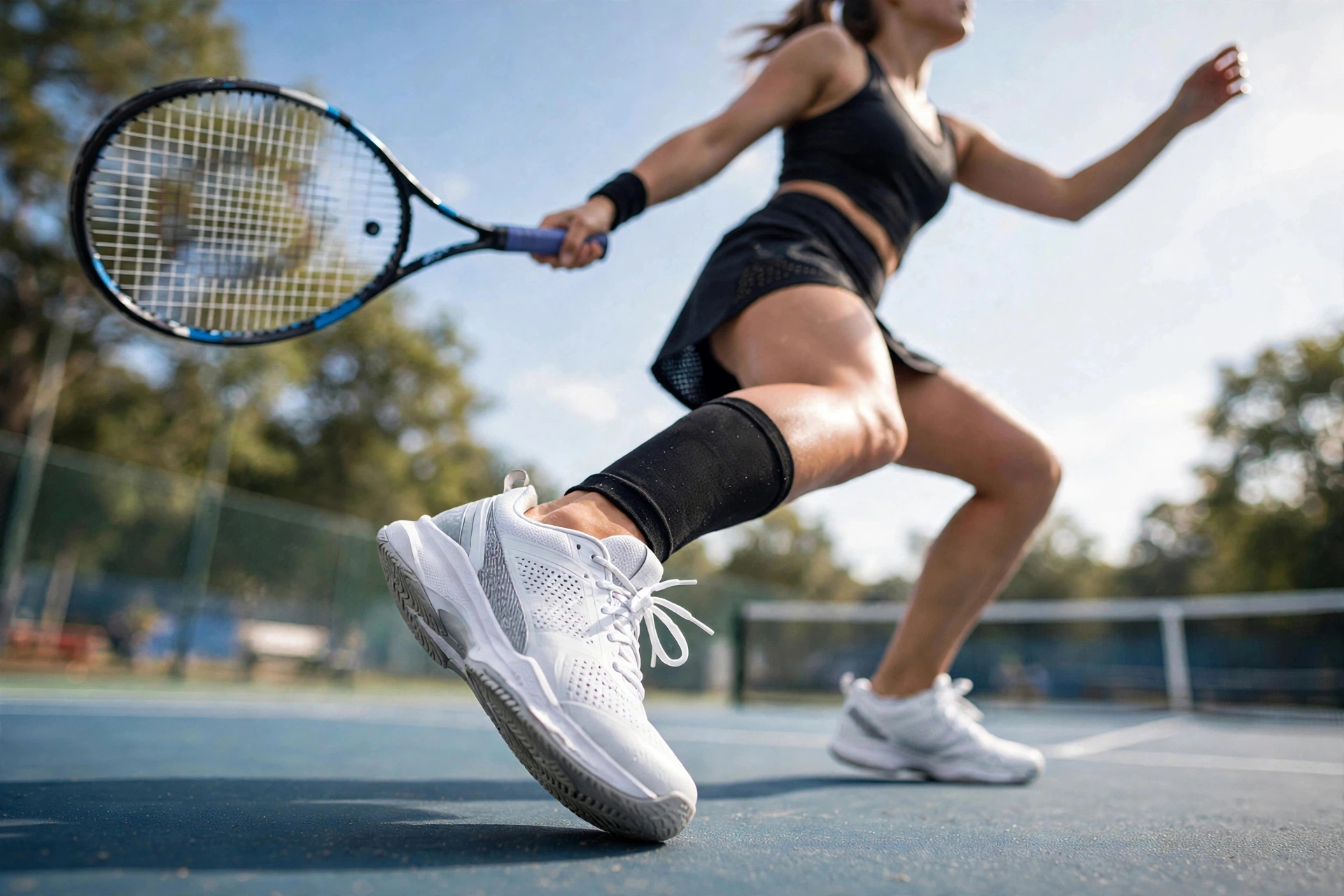
Finding the best tennis shoes for women is harder than it should be. Most roundups of the best women’s tennis shoes read like the men’s list with pink added. They skip the stuff that actually matters: how the shoe fits a woman’s foot, what happens if your heels slip, whether it’ll wreck your arches on day one.
Fit problems are the norm, not the exception. A heel cup that slides. A toe box that bruises nails. A sizing note that tells you to go half up and leaves you with shoes half a size too big. You’ll see that exact complaint in buyer reviews below, repeated across brands.
So we built this ranking of the best tennis shoes for women differently. We read through hundreds of owner reviews, Talk Tennis forum threads, Tennis Warehouse playtester reports, and RunRepeat lab measurements. The picks below are built on what real players say after months of play, not what a brand page promises.
No fake testing stories here. Just the best women’s tennis shoes, sorted by the foot problem they solve.
How we picked these
We didn’t personally wear-test these shoes, and we’re not going to pretend we did. Every pick comes from real player feedback gathered across Talk Tennis forums, Tennis Warehouse playtester reviews and buyer ratings, RunRepeat lab data, and retailer reviews on Tennis Warehouse, Dick’s, and Zappos. That’s a better foundation than copying marketing copy, because it tells you what actually happens after three months of hard-court play: which shoes kill arches, which heel cups slip, which warranties get honored. We kept the good and the bad, and we’ll tell you exactly who should skip each shoe.
Our top picks
- adidas Barricade 14: Best Overall. The most complete package of comfort and stability we found.
- ASICS Gel-Challenger 15: Best Stable Workhorse. Most of the durability of a flagship model.
- New Balance CT Rally v1: Best Cushioning. Joint-friendly cushion plus wide widths that actually run wide.
- Wilson Rush Pro 4.5: Best Arch Support. The pick for flat feet and ball-of-foot pain.
- ASICS Court FF 3: Best for Narrow Feet. Lockdown like a sock, but you have to fight to get it on.
- Mizuno Wave Enforce Tour 2: Best for Heel Pain. Plush from the first wear, just order half up.
- Wilson Rush Pro Ace: Best Value. Roomy, comfy, and easy on the wallet.
- ASICS Gel-Dedicate 8: Best Budget. Real stability tech in a budget shoe.
- adidas Avacourt 2: Best Women’s-Specific Comfort. Built on a women’s last, plush out of the box.
- Prince T22: Best for Wide Feet. A cult classic that’s easy on plantar fascia.
Quick comparison
| IMAGE | SHOE | BEST FOR | FIT NOTES | PRICE |
|---|---|---|---|---|
 | adidas Barricade 14 | Best Overall | True to size, snug-medium; go half up if wide | Check Price |
 | ASICS Gel-Challenger 15 | Best Stable Workhorse | True to size, medium width | Check Price |
 | New Balance CT Rally v1 | Best Cushioning | True to size; wide (D/2E) available | Check Price |
 | Wilson Rush Pro 4.5 | Best Arch Support | True to size, narrow-medium; half up if wide | Check Price |
 | ASICS Court FF 3 | Best for Narrow Feet | True to length, narrow; snug sock-like entry | Check Price |
 | Mizuno Wave Enforce Tour 2 | Best for Heel Pain | Runs short: order half size up | Check Price |
 | Wilson Rush Pro Ace | Best Value | True to size, roomy toebox | Check Price |
 | ASICS Gel-Dedicate 8 | Best Budget | True to size; half up if between sizes | Check Price |
 | adidas Avacourt 2 | Best Women’s-Specific Comfort | Start with true size; snug medium | Check Price |
 | Prince T22 | Best for Wide Feet | True to size, medium-wide, roomy | Check Price |
If you’re still deciding, the safest starting point among the best tennis shoes for women above is the Barricade 14 for all-around stability or the CT Rally v1 if your feet run wide. Our detailed reviews of the best tennis shoes for women below dig into who should skip each one.
1. adidas Barricade 14: Best Overall
The most complete package of comfort and stability you can buy right now. Just don’t expect the old Barricade’s legendary durability, because that part of the legend didn’t make it into this version.
The Barricade 14 is the shoe Tennis Warehouse’s women’s playtesters kept circling back to, and the numbers explain why. Comfort 8.6, ventilation 8.7, stability 8.9, final verdict 8.7. That’s the rare combo of a shoe that holds you up without punishing your feet. Playtester Tiffani, who has wide feet and low arches, reported no break-in, better breathability than the Barricade 13, and lacing that actually works. That’s a meaningful upgrade, because the 13’s lacing setup frustrated plenty of people.
What changed versus the old Barricades is the philosophy. This one is lighter, airier, and cushioned from day one. One buyer who switched from the 13 called it the perfect combo of stability and cushioning, and a direct Talk Tennis comparison found it snugger, less bulky, and more responsive than the Gel-Resolution X. If your memory of the Barricade line is “heavy tank,” this isn’t that anymore. Good. That tank era had its fans, but your knees have opinions too.
Now the blunt part. Durability is not what it was. Tennis Warehouse scored sole durability at 7.9, and long-time Barricade wearers describe the 14’s outsoles as the softest and thinnest of the line. If you play hard daily, plan on about three to four months before they’re done. That’s genuinely disappointing for a line built on outlasting everything. The break-in story is also disputed: Tennis Warehouse says none, but one Talk Tennis owner needed eight to ten hours before the shoe felt right. And the Lightstrike Pro cushioning reportedly loses some of its bounce after three to four weeks, per a Talk Tennis owner. Buy it for the comfort and lockdown, not for a shoe that survives a full season.
What players say: Talk Tennis owners are warm on the fit and ride, describing better lockdown and more energy return than bulkier rivals. Tennis Warehouse reviewers echo the out-of-box comfort. The complaints are consistent across both sources: outsoles wear faster than the Barricade name promises, half-sizes run small, and a few owners went half a size up because the Achilles padding eats some length.
Who should skip it: If durability is your number one priority, this isn’t your shoe. The Gel-Resolution X outlasts it. Truly wide feet should look elsewhere too, and if you want a soft, plush ride, the CT Rally v1 is the one that delivers that.
Sizing: Tennis Warehouse lists length as true and width as snug medium. Most players stay true to size, but go half up if you’re wide, between sizes, or your Achilles is sensitive. Adidas half-sizes run a touch small.
Pros
- Best comfort-stability combo in this roundup, playtest-verified
- No break-in for most wearers, breathable mesh upper
- Snug, secure lockdown that beats bulkier flagships
- 6-month outsole warranty
Cons
- Outsole durability (7.9) is the line’s weakest in years
- Energy return fades after a few weeks of play
- Snug-medium width, not a wide-foot shoe
- Half-sizes run small; sizing takes a little care
2. ASICS Gel-Challenger 15: Best Stable Workhorse
Near-flagship stability without the flagship badge. That’s the whole pitch, and the community has decided it’s true.
The Gel-Challenger 15 keeps showing up in Talk Tennis threads as the answer to one question: what do I buy now that the Gel-Resolution 9 is gone? One thread reports a YouTube reviewer calling it “basically the GelRes9,” and a varsity junior tester said it was just as good as the Resolution 9 and more comfortable, then bought a second pair for school. RunRepeat’s lab called it a “Mini-Me of the ASICS Gel Resolution,” noting the identical traction pattern to the Resolution X. SoleLabReviews praised the stable ride and durability. When the players who test shoes for a living keep landing in the same place, listen.
Out of the box, it’s an easy shoe to like. Tennis Warehouse lists break-in as none for the women’s version, and the padded collar and soft upper feel comfortable right away. It’s stable without feeling like a brick, which is the balance most daily players actually want. And it delivers most of the flagship stability without the flagship bulk. One Talk Tennis buyer tried several top-end shoes and called the Challenger 15 her favorite in a while, stable and comfortable without the clunk of heavier models.
The 15th generation came with real tradeoffs, and I’ll be straight about them. It got heavy. Women’s is 12.3 ounces, up from the previous version, and Talk Tennis owners noticed, with one saying the light weight was why she liked Challengers in the first place. The breathable mesh upper of old is gone, replaced by a plasticky synthetic that several Tennis Warehouse reviewers called crunchy and non-breathable. Breathability is the dominant complaint in the women’s reviews. Cushioning is also below average by lab numbers, so joint-pain players wanting max softness should pass. One more thing you deserve to know: a Talk Tennis poster reported falling four to five times after catching the side of her foot on the plasticky midfoot. That’s a safety-adjacent complaint worth disclosing, not burying. And unlike the flagships, there’s no 6-month outsole warranty here. ASICS ended that program in December 2020.
What players say: Talk Tennis owners love the value story and the stable, comfortable ride, repeatedly framing it as the sensible Resolution substitute. Tennis Warehouse women’s reviewers agree on comfort but are blunt about the plasticky upper and reduced breathability, rating it 3.8 out of 5. A note on evidence: forum chatter and lab data are solid here, but I didn’t find dedicated video reviews or Reddit threads for this one, so I’m attributing what I actually have.
Who should skip it: Wide feet, because it comes in medium width only. Players in hot climates or heavy sweaters, because the upper doesn’t breathe like it used to. Max-cushioning seekers with joint pain. Aggressive sliders, because of the upper and that fall complaint. And anyone who wants a warranty, because there isn’t one.
Sizing: Consensus is true to size. Tennis Warehouse lists length true and width medium, and 75% of Zappos women’s reviewers agreed. Go half up only if you’re between sizes. Narrow-to-medium feet fit best.
Pros
- Community’s chosen Gel-Resolution 9 stand-in
- Stable and nimble, comfortable out of the box with no break-in
- Solid outsole durability, PGUARD toe protection
- Accommodating fit for narrow-to-medium feet
- The value pick of the ASICS lineup
Cons
- Heavier than the last generation (12.3 oz women’s)
- Plasticky upper, breathability noticeably worse than older models
- Below-average cushioning and energy return
- No wide widths available, medium only
- No 6-month outsole warranty
3. New Balance CT Rally v1: Best Cushioning
The wide-foot default and the joint-friendliest stability shoe here. If your feet hurt in other shoes, start with this one.
The CT Rally v1 pairs Fresh Foam X cushioning with real stability, and tennis.com called it a worthy successor in the premium cushioned-stability lane. Talk Tennis owners describe it as hugely cushiony yet still responsive, not the dead feeling you sometimes get from soft shoes. But the detail that matters most is the fit. True D-wide and 2E options exist, and even the standard width runs roomy in the toe box. A bunion sufferer reported the shoe doesn’t hurt bunions and bought a second pair just to stash. Multiple plantar fasciitis owners say their symptoms resolved. One long-term owner whose knee and hip aches disappeared on the CT Rally reports going back to it after a bad experiment with something else. That’s not marketing copy. That’s what loyalists sound like.
There’s also real warranty confidence behind this one. A Talk Tennis poster got a heel-wear warranty claim approved, so the 6-month outsole warranty is honored, not theoretical. And since the v1 is being cleared out for the v2, it’s strong value for a premium shoe. For players with wide feet, bunions, or plantar fasciitis, this is arguably the best tennis shoe for women on the market right now.
Caveats, honestly delivered. The cushioning is firm, not plush. Owners describe it as “comfortable but firm,” so if you’re picturing HOKA-level softness, reset expectations. It runs warm, and players in heat above 80 degrees notice. Some owners report heel slippage since the ankle area runs a little wide; a runner’s knot usually fixes it. And the real risk isn’t quality, it’s availability. The v1 is discontinued in favor of the v2, so colorways and sizes are thinning. If your size is in stock, that matters more than waiting.
What players say: Talk Tennis owners are devoted, especially wide-footed players and those with foot pain. Tennis Warehouse playtesters scored arch support highly, in the 8 to 9 range. The recurring criticisms, firm ride and warm upper, are consistent enough that you should take them seriously. Evidence here is forum and retailer heavy; it’s thin on dedicated video reviews.
Who should skip it: Narrow feet, because the roomy fit becomes a lockdown problem and heel slip gets worse. Max-plush seekers. Players who run hot. And if you need a full size run of the newest model, the v2 is the better bet.
Sizing: True to size, and the D width is genuinely wide. 2E available for very wide feet. The toe box is wide with a narrower midfoot and heel, per tennis.com. Little to no break-in.
Pros
- Fresh Foam X cushioning with genuine stability, not mush
- True D-wide and 2E options, the wide-foot default
- Bunion and plantar fasciitis owners report real relief
- 6-month outsole warranty, honored in practice
Cons
- Firm, not plush, don’t expect cloud-soft
- Runs warm above roughly 80 degrees
- Some heel slippage, runner’s knot often needed
- v1 discontinued, sizes and colorways thinning
4. Wilson Rush Pro 4.5: Best Arch Support
The verdict: the arch-support champion for low-arched feet, and a tricky pick for everyone else.
Here’s the thing about the Rush Pro 4.5. It doesn’t try to be the softest shoe or the fastest shoe. It tries to hold your foot properly, and for the right feet it does that better than anything else in this guide.
A near-flat-footed Talk Tennis owner put it plainly after six months: best arch support they’d had in a tennis shoe, with ball-of-foot pain gone. That tracks with what tennis.com found too, where the TPU plate and lateral chassis kept the shoe stable through sharp cuts. The upper is airy and flexible, so there’s little to no break-in, and the Endofit inner sock adapts to your foot shape. Toe box is fairly roomy for toes to splay, a wide model exists, and it’s worn on tour by players like Marta Kostyuk and Peyton Stearns. Wilson backs the outsole with a six-month warranty.
Now the honest part. Heel slip is the most repeated complaint, especially for narrow heels, and the runner’s knot fix is close to universal advice among owners. The arch support itself can be too much of a good thing: one wide-footed owner with low-to-medium arches said it wrecked their arches, because the midfoot runs too skinny for them. If your arches are high and rigid, they may fight the firm support rather than sink into it. And don’t buy this expecting a cloud: forefoot cushioning is moderate, so joint-pain players chasing maximum softness should look at the CT-Rally line instead. There’s a sizing wrinkle worth flagging: multiple owners call it true to size, but Tennishead sized up half for medium-to-wide feet. If you’re wider than medium, try it on first. One more thing from a Talk Tennis poster: the women’s last has a narrower heel than the men’s, so don’t judge the women’s fit by reviews of the men’s version.
What players say: Talk Tennis owners with flat feet keep coming back to the arch support as the reason they stay with this shoe, with one reporting six months of pain-free play after other shoes hurt. Tennis.com’s review backs the stability side, noting how the chassis handles hard lateral cuts. On the flip side, wide-footed owners warn the midfoot feels skinny and a few found the arch pressure uncomfortable rather than supportive.
Who should skip it: very wide feet (the snug midfoot is the weak spot), anyone chasing max cushioning over support, high rigid arches that clash with firm arch structure, and lightest-speed seekers who live in Ubersonic or Solution Speed territory.
Sizing: true to size for narrow-to-medium feet; consider a half size up if you’re medium-to-wide; learn the runner’s knot because the heel runs roomy on some feet.
Pros
- Standout arch support for low arches and overpronation
- Stable through cuts thanks to the TPU plate and lateral chassis
- Comfortable out of the box with little to no break-in
- Six-month outsole warranty
Cons
- Heel slip on narrow heels is common
- Aggressive arch can punish the wrong foot shape
- Forefoot cushioning is only moderate
- Slim-leaning midfoot, so wider feet need to size up or try first
5. ASICS Court FF 3: Best for Narrow Feet
The verdict: ASICS’s top-tier stability tool for narrow feet, if you can get past the doorway.
The Court FF 3 is the shoe you buy when you want to be planted. Tennis Warehouse’s women’s playtest gave it a Final score of 8.6, with Traction at 9.2 and Stability at 8.8. RunRepeat’s lab work backs that up: maximum torsional rigidity, elite grip, and a Dremel outsole test showing only 0.4mm of wear, the best in class. The one-piece Mono-Sock upper wraps your foot in a sock-like lockdown that narrow-footed buyers love, and forefoot shock absorption measures strong at 77 SA with a thick 32.2mm heel stack. Tennis Warehouse playtesters logged 10 to 12 hours with minimal smoothing of the tread. This is a serious court tool.
The catch is real, though. The number one gripe isn’t performance: it’s getting the shoes on. The narrow Mono-Sock opening is hard to push your foot through, there’s no heel pull tab, and one Tennis Warehouse buyer left a one-star review because they couldn’t get their foot in at all. The toe box runs narrow and snug (RunRepeat measured 66.2mm versus a 69.3mm average), and one playtester with wider feet got toe numbness. Two wear issues showed up over time: the upper stretches with use, which loosens that prized lockdown, and the heel padding wears fast (RunRepeat gave it 2 out of 5). It’s heavy at around 12.9 ounces, breathability is mediocre, and here’s the one that matters for hard-court players: ASICS discontinued its six-month outsole warranty program in December 2020, so the Court FF 3 carries no sole guarantee. That stings.
What players say: Tennis Warehouse women’s playtesters and buyers with normal-to-narrow feet praise the built-in tongue and the locked-in feel on pivots, and the stability and traction scores speak for themselves. But the difficulty of getting the shoe on is a recurring theme in women’s reviews, and the snug toe box drew real complaints, including toe numbness from a wider-footed playtester. (Note: women’s-specific community discussion of this shoe is thin, so most of the owner evidence here comes from Tennis Warehouse testers and buyers rather than forums.)
Who should skip it: wide feet, full stop, since this comes in standard B width only with no wide option; hard-court grinders who want a warranty safety net (the Gel-Resolution 9 is the better call there); speed seekers, since this is a stability tank; and heat-sensitive feet, because breathability is average at best.
Sizing: true to length but narrow in fit; go half a size up if you’re between sizes or dislike the sock-fit entry; standard B width only, no wide option.
Pros
- Elite traction and stability backed by playtest and lab scores
- Sock-like Mono-Sock lockdown narrow feet will love
- Strong forefoot shock absorption with a thick heel stack
- Lab-best outsole wear for hard-court durability
Cons
- Getting them on is genuinely difficult, with no heel pull tab
- Runs narrow and snug, with a low, tight toe box
- No six-month outsole warranty (ASICS ended the program in 2020)
- Heavy at around 12.9 ounces with mediocre breathability
6. Mizuno Wave Enforce Tour 2: Best for Heel Pain
The verdict: one of the best-cushioned women’s tennis shoes of 2026, but the soft ride trades lateral support.
If heel pain or plantar fasciitis is what sends you hunting through lists of the best tennis shoes for women, this one deserves your attention. Tennis Warehouse’s women’s playtest team loved it: the Enerzy NXT cushioning is genuinely plush and soft, it’s comfortable straight out of the box with no break-in, and the uppers are soft and pliable rather than stiff. The outsole earned a 9.2 for sole durability, the top score, which is unusual for a comfort-first shoe. RunRepeat picked it as a top option for plantar fasciitis, and Mizuno backs it with a six-month outsole warranty.
The sizing needs a clear warning, and this is where honesty matters: the women’s version runs short. Tennis Warehouse’s women’s guide is explicit about it, and the unanimous fix is ordering a half size up. Oddly, the men’s side reports true to size, so this short-running is concentrated in the women’s last. That half size up creates a second problem for some women: the toe box is roomy, so medium-width feet that size up can end up with a shoe that feels too wide and unsupportive. Then there’s the tradeoff the soft ride forces. Stability scored 7.6, the lowest here, and a few players reported their feet sliding side to side in competitive singles. The highest-arched playtester needed aftermarket insoles after a week. Some narrow-footed women never got real lockdown, and v1 loyalists describe v2 as stripped down, slightly less plush and lower to the ground. Heel slippage shows up in the complaints too, with one recurring note that the double heel collar was removed.
What players say: Tennis Warehouse’s women’s playtest team and customer reviews (4.2 out of 5 across ten reviews) consistently praise the out-of-box comfort and the plush cushioning, and the sole durability impressed for a shoe this soft. The complaints are just as consistent: competitive players found the lateral support lacking, high-arched players reached for insoles, and v1 fans feel the sequel lost some of its plushness. (Women’s-specific forum and retail discussion of this shoe is thin, so most evidence here comes from Tennis Warehouse testers and buyers rather than community forums.)
Who should skip it: narrow feet that need lockdown, very high arches that need firm support rather than soft cushioning, aggressive competitive singles players who need a locked-in shoe, and speed demons who want a low, connected feel. For more support-oriented options around heel pain, see our plantar fasciitis guide.
Sizing: women’s version runs short, so order a half size up; medium-to-wide feet fit best; narrow feet will likely swim in the roomy toe box.
Pros
- Plush Enerzy NXT cushioning, comfortable out of the box
- No break-in needed
- Sole durability 9.2, excellent for a comfort shoe
- Six-month outsole warranty, claims via Mizuno
Cons
- Women’s version runs short in length
- Stability lags the plushness: 7.6, lowest here
- Roomy toe box gives narrow feet no lockdown
- v2 feels less plush than v1 to loyalists
7. Wilson Rush Pro Ace: Best Value
Verdict: a comfort-first, roomy-toebox value pick, as long as you plan on swapping the thin stock insole.
The Rush Pro Ace is the relaxed one in Wilson’s Rush Pro family. Talk Tennis owners describe it as comfier, a touch bouncier, and slightly bulkier than the Rush Pro 4.5. That one’s stiffer, lighter, and sits closer to the ground. The Ace is the version you buy when you want your feet to feel good at the end of the match, not necessarily when you’re chasing down every drop shot.
The toebox is the real headline. RunRepeat measured it at 72.7mm near the big toe against a 69.3mm average, one of the widest tennis shoe toeboxes they’ve tested. It’s also taller than average. Your toes can spread out, which matters if you’ve ever finished a set with your pinky toes throbbing. Underneath, the chassis isn’t some watered-down budget frame: torsional rigidity 4/5 and heel counter 4/5, barely behind the Rush Pro 4.0. Traction runs average, surefooted but forgiving enough to slide a little.
Now the honest part. The stock insole is thin, 4.0mm against a 5.2mm category average, so budget a swap if you need real cushioning underfoot (plenty of owners just drop in their own orthotics). The heel-collar lining wears fast too, and breathability is middling at best. And one warning that matters: the 6-month outsole warranty is genuinely disputed on this model. Wilson AU lists it, Midwest Racquet Sports in the US says Ace models carry no warranty, and Wilson excludes Amazon marketplace purchases anyway. Don’t count on it.
What players say: Talk Tennis owners consistently call the Ace the comfier, cushier sibling of the 4.5, with a noticeably roomier toebox. One Reddit poster noted their daughter has wide feet and loves her Rush Pro Ace pair. Gripes center on the thin insole and fast-wearing heel collar lining, which match the lab findings. One Dick’s reviewer wished for a bit more arch support. (Women’s-specific Reddit evidence on this model is thin: handle with care, and the comfort claims come mostly from forum owners, not lab marketing.)
Who should skip it: Speed players and aggressive movers who want a stiff, low, responsive ride should look at the Rush Pro 4.5 instead. Hot-footed players too, since the breathability is only average.
Sizing: True to size in the RunRepeat poll (31 votes). One nuance: the “wide” feel is really toebox volume, width and height near the toes, not extra width through the whole foot. Medium-wide feet are generally fine in the standard width.
Pros
- One of the widest toeboxes tested in its class, roomy and tall
- Solid chassis: 4/5 torsional rigidity and heel counter at a value price
- Comfortable out of the box, softer ride than the 4.5
- Strong toe-guard durability, average hard-court outsole wear
Cons
- Stock insole is thin: budget for an insole or orthotic swap
- Heel-collar lining wears through fast
- Breathability middling (3/5), synthetic overlays run warm
- 6-month warranty coverage is disputed, don’t promise it
- Bulkier feel than the 4.5, one owner felt off-balance on landings
8. ASICS Gel-Dedicate 8: Best Budget
Verdict: the best budget tennis shoe with real stability tech, for beginners and 1-3x/week players who know its limits.
This is one of the rare budget shoes that doesn’t feel like a compromise where it counts. GEL cushioning up front plus a TRUSSTIC shank means actual stability tech in a budget shoe, and it’s light at around 11.2 oz. There’s no break-in: you lace them up and play.
My favorite detail from the research: one Talk Tennis owner compared the Dedicate 8 side by side with the ASICS Solution Speed FF 3, couldn’t tell the fit and cushioning apart, and returned the expensive one. Tennis Guy called it the Best Budget Tennis Shoe of 2025. That’s the story of this shoe in a nutshell.
But a budget price has to give somewhere, and it’s durability. The lab is explicit that compromises were made to hit the budget, and Zappos reviews are split: some owners say they last forever, others burned through the soles in weeks of daily play. Cushioning has a ceiling too. A Talk Tennis regular reported feet feeling tender on the bottoms after three hard sets. Fine for casual play, not for marathons. There’s also no 6-month outsole warranty, and women’s-specific feedback is genuinely thin here, so most of what we know transfers from the near-identical shared platform. Worth saying plainly.
What players say: Talk Tennis owners rate the out-of-box comfort highly and repeatedly praise the stability for a budget shoe. The cushioning ceiling comes up often: three hard sets and feet start feeling it. Heavy hitters find the limit fastest. Zappos buyers split on durability, with daily-play users seeing soles go quickly. The comparison-with-Solution-Speed-FF-3 story above is one owner’s honest side-by-side, and Tennis Guy’s budget-pick nod is on video. No substantive Reddit discussion surfaced on this one, so claims rest on forums and retailer reviews.
Who should skip it: Competitive players on court 4 or more times a week, anyone who wants a 6-month outsole warranty, and players with knee issues who need max shock absorption (one reviewer found hard courts jarring).
Sizing: True to size for average feet (about 75% on Zappos). Go a half size up if you’re between sizes or slightly wide. ASICS does make wide widths in this line, which helps.
Pros
- GEL + TRUSSTIC stability tech you rarely see in budget shoes
- Comfortable immediately, zero break-in
- Light: around 11.2 oz keeps it nimble
- One owner couldn’t distinguish it from the Solution Speed FF 3
- Wide widths available in the line
Cons
- Durability is the tradeoff: daily players wear through fast
- Cushioning ceiling: feet feel it after long hard sessions
- No 6-month outsole warranty
- Women’s-specific owner feedback is thin
- Not enough shock absorption for knee-sensitive players
9. adidas Avacourt 2: Best Women’s-Specific Comfort
Verdict: the most genuinely women’s-specific pick here, plush and stable, but the sizing advice needs real care.
Most “women’s” tennis shoes are men’s designs in smaller sizes. The Avacourt 2 stands apart. adidas built it on female foot research, a real women’s last, which makes it one of the genuinely women’s-specific options among the best tennis shoes for women this year. And owners feel the difference. Tennis Warehouse buyers rate it 4.3/5 across 35 reviews, Dick’s reviewers 4.3/5 across 47 with 91% recommending. The comfort headline is consistent: plush Bounce Pro cushioning, a soft heel collar, no break-in needed. Medium feet get a secure fit with good lateral stability, and it works on both hard court and clay. Tennis and pickleball both.
Now the part you need to read twice: sizing is a genuine minefield on this shoe. Tennis Warehouse’s fit note says it’s snug and suggests going a half size up if you’re between sizes. But multiple buyers followed that advice and got shoes half a size too big, unwearable in matches. Meanwhile other owners, especially wide-footed ones, found them way too small. One Dick’s reviewer with a wide tall foot called them “very compressed.” Here’s the honest guidance: start with your true size. Only go up half if you’re truly between sizes. If your feet are wide, this shoe probably isn’t your shoe at all.
Also know: there’s no durability guarantee, a few Dick’s reviewers flag wear with regular play, and at 11.7 oz a couple of match players call them a touch clunky or slow next to lighter speed shoes.
What players say: Tennis Warehouse and Dick’s reviewers (80+ combined, overwhelmingly women) call these among the most comfortable court shoes they’ve owned, with the plush heel collar getting special mention. The sizing confusion is the biggest complaint thread by far: TW’s “half up if between sizes” note backfired on several buyers who ended up with shoes too big, while wide-footed owners found them too small. Several wide-footed owners returned them. A few Dick’s reviewers question durability with regular play, and match players occasionally find them a touch heavy.
Who should skip it: Wide feet or bunions, full stop, the toe box is too tight (see our guide to best tennis shoes for bunions for better options). Also skip if you need a 6-month warranty, drag your toes aggressively, or expect a lightweight speed shoe.
Sizing: True to size for narrow-to-medium feet. Half a size up ONLY if you’re between sizes, and don’t stack TW’s advice on top of a roomy guess. Wide feet should look elsewhere.
Pros
- Genuinely women’s-specific last, not a scaled-down men’s shoe
- Plush Bounce Pro comfort, soft collar, zero break-in
- Good lateral stability for medium feet
- Versatile on hard court and clay
Cons
- Sizing is genuinely confusing, and retailer fit notes misled some buyers
- Toe box too narrow for wide feet or bunions
- No durability guarantee, some wear complaints with regular play
- A touch clunky at 11.7 oz for match players wanting speed
- No 6-month outsole warranty
10. Prince T22: Best for Wide Feet
Verdict: the comfort-and-value cult classic for recreational women, if you can live with the weight.
The T22 has been around forever and keeps selling for a reason. Wide stable base, plush padding, a low-to-ground ride, comfortable from the first wear. It sits at 4.5/5 across 77 reviews as a current Tennis Warehouse bestseller, which is remarkable staying power for a shoe this old.
The plantar fasciitis endorsements are the strongest thread in the research. Multiple Talk Tennis users endorse it for PF, one recovered sufferer switched and played pain-free, and the thread summary is blunt: “great for PF.” Honest caveat: one dissenter found them inadequate once their PF worsened, so think supportive, not orthopedic. The 6-month outsole warranty is the real deal too, and owner-confirmed honored: one player wore through in 4 months of hard-court play, shipped them back, and Prince replaced them. Eight months of heavy use from one warranty claim is genuinely good math.
The knock everyone repeats: heavy and clunky. TT posters call them “clunky-looking,” one all-black owner said “Frankenstein shoes.” A high-arch wide user loves the fit but admits feeling the weight, and eyeing lighter Vapors. Also watch the fit across colorways: one long-term user found the conservative white/blue fits narrower, like the T10, while newer colorways run roomier. And be honest about “wide”: it’s roomy for most feet but not a true wide last, and very wide users report the side stability bands pressing on their smallest toes. The richest Talk Tennis threads are from 2011-2016, but the shoe is still in production and a current bestseller, and the praise themes haven’t changed across eras.
What players say: Talk Tennis users are loyal across years: breathable, supportive, durable on hard court, with one Italian player calling it the most breathable summer shoe they owned. The PF endorsements are real and repeated, with the honest exception of one user whose PF outgrew what the shoe could support. The honored 6-month warranty story is one owner’s verified experience, worn through in 4 months and replaced. Weight is the universal complaint, and one long-term user warns fit varies by colorway. No substantive Reddit evidence surfaced, and recent retailer reviews are thinner than adidas-level volume, so the cult-loyalty claims rest on long-running forum threads.
Who should skip it: Speed players who want a light, fast feel, anyone needing max lateral stiffness for aggressive sliding, and very narrow feet (though one narrow-footed user managed fine with double socks).
Sizing: Runs true to size, medium-wide with a generous toe box, no break-in. No wide widths made, the standard just runs roomier than most. If you’re between sizes or have a very wide forefoot, try them first since fit varies by colorway.
Pros
- Wide-friendly fit with plush padding, comfortable out of box
- Strong PF/heel-pain endorsements from long-term forum users
- 6-month outsole warranty actually honored (owner-confirmed)
- Current TW bestseller at 4.5/5, remarkable staying power
- Great value with Shock Eraser midsole
Cons
- Heavy and clunky, the most repeated knock
- Fit varies by colorway, warn and try first
- “Wide” is roomy, not a true wide last; side bands can press smallest toes
- Arch support only moderate, not a high-support shoe
- Old-school looks (“Frankenstein shoes” per one owner)
Find your shoe by foot condition
Most buyers guides to the best tennis shoes for women ignore feet and talk about foam. That’s backwards. A shoe that’s perfect for one player can be a blister factory for another, so start here and match the shoe to what hurts.
Plantar fasciitis
Two shoes on this list have real owner-reported PF relief behind them. The New Balance CT Rally v1 is the headliner: multiple PF owners say their symptoms cleared up once they switched, and its stable heel keeps the midfoot from wobbling around. The Wilson Rush Pro 4.5 helps a different way, with ball-of-foot and arch support that takes load off the fascia during play.
The Mizuno Wave Enforce Tour 2 is RunRepeat’s top pick for plantar fasciitis, thanks to its plush Enerzy NXT cushioning, so soft-landing seekers should look there. The Prince T22 has Talk Tennis users endorsing it for PF too, mostly crediting the Shock Eraser midsole. Honest caveat: one dissenter found the T22 inadequate once their PF got severe, so it’s supportive, not a treatment. If this is your main concern, our dedicated guide to the best tennis shoes for plantar fasciitis goes deeper.
Flat feet
Wilson Rush Pro 4.5 is the arch-support champion of the group. A near-flat-footed Talk Tennis owner called it the best arch support they’d ever had in a tennis shoe, and the built-in TPU plate stops the midfoot from collapsing on hard cuts. If you overpronate or get ball-of-foot pain, start here.
The CT Rally v1 is the backup plan: Tennis Warehouse playtesters rated its arch support 8 to 9, and its heel stays planted when the 4.5’s firm arch feels like too much. Our roundup of the best tennis shoes for flat feet has more options if neither fits your budget.
Wide feet
Honest ranking for wide feet: CT Rally v1 first, then Prince T22, then Barricade 14, then Rush Pro 4.5 last. The CT Rally wins because it comes in a true D-wide and even 2E, and even its standard width is roomy through the toe box. The T22 is medium-wide with a generous toe box, but here’s the honest part: it’s roomy for most people, not a true wide last. The Barricade 14 runs snug-medium, so wide-footed buyers usually go half a size up. The Rush Pro 4.5 has the snuggest midfoot of the four, so it’s the weakest pick here.
And avoid the narrow end entirely. The ASICS Court FF 3 has no wide option and a narrow entry that’s already hard to get into, and the Avacourt 2 has a narrow toe box that several wide-footed owners returned. If your heel slides in a roomy shoe, that’s a lacing problem, not a width problem: learn the runner’s knot before sizing down.
Bunions
The CT Rally v1 gets the clearest bunion endorsement we found: one sufferer reported the toe box didn’t press on their bunions and liked it so much they bought a second pair to stash. The Wilson Rush Pro Ace is the other safe pick, with one of the widest toe boxes RunRepeat has ever measured on a tennis shoe.
One more foot note while you’re here: if you have high arches, check our guide to the best tennis shoes for high arches. The Wave Enforce Tour 2’s soft ride suits some high-arched players, but the highest-arched Tennis Warehouse playtester needed aftermarket insoles after a week, so don’t assume cushioning alone will do it. And if bunions are the main issue, our best tennis shoes for bunions guide rounds out the options.
Match the shoe to how you play
Foot shape gets you in the right size. Play style gets you in the right shoe. Here’s the quick version.
Baseline grinder
adidas Barricade 14. You live in long rallies and need stability that doesn’t quit in the third set. It’s also worth a look at the Gel-Challenger 15, which owners call a near-flagship performer with honest stability and durability.
Serve-and-volley / doubles
ASICS Court FF 3 if your feet are narrow enough to get into it: the traction and lockdown on pivots are genuinely elite. For everyone else, the Wilson Rush Pro 4.5 stays stable through sharp cuts and stays light enough that net play doesn’t feel sluggish.
All-court recreational player
Wilson Rush Pro Ace is the comfort-first value play, roomy and easy. The Avacourt 2 is plush and handles hard court and clay both, and the Prince T22 is the old-school cult classic for players who don’t mind a heavier shoe.
Beginner
ASICS Gel-Dedicate 8. Real stability tech for a budget price, no break-in, and it’ll do everything a beginner needs. The honest limit: it’s built for 1-3 sessions a week, not daily play, so heavy hitters will outgrow it fast. Before you buy anything, read our guide on how tennis shoes should fit. Most beginners buy a half size too small and blame the shoe.
The 6-month outsole warranty, explained
Some tennis shoe brands will replace your shoes for free if you wear through the outsole within six months of purchase. That’s it. That’s the warranty. It covers worn-through rubber only, it’s a one-time replacement, and you usually claim it through the retailer you bought from. It exists because hard-court players can burn through a pair in a season, and it’s genuinely valuable if you play a lot.
Here’s how the ten shoes in this guide stack up. YES: Barricade 14, CT Rally v1 (owner-confirmed that New Balance honored it), Rush Pro 4.5, Wave Enforce Tour 2 (claims go through Mizuno), and Prince T22 (owner-confirmed that Prince honored it). DISPUTED: Rush Pro Ace. Wilson Australia lists it as covered, but US retailers say Ace models aren’t, so treat it as uncertain and buy assuming there’s no coverage. NO: Gel-Challenger 15, Court FF 3 (ASICS discontinued its program back in December 2020), Gel-Dedicate 8, and Avacourt 2 (Tennis Warehouse explicitly lists “Durability Guarantee: No”). No hype, no fine print games: check the retailer’s listing before you buy, because warranty terms can change by seller.
How long tennis shoes last (and when to replace them)
For most recreational players, a pair of tennis shoes lasts 6 to 12 months, which works out to roughly 60 to 100 hours of court time. Heavy hard-court players get less. Much less. Three to four months is normal if you’re out there daily, and the Barricade 14’s middling durability score is a reminder that even premium shoes have limits on hard courts.
Don’t guess. Look at your shoes. The signs it’s time: the outsole tread is smoothing out, you’ve worn through to a spot, the heel counter is collapsing, or new aches show up that weren’t there before. Your body notices dead cushioning before your eyes do.
Two things affect that timeline. Cleaning your shoes extends their life a bit, though it won’t bring worn rubber back, and hard courts eat shoes fastest while clay is much gentler on them. If you want the full picture, read how to wash tennis shoes and our breakdown of the types of tennis courts. And honestly? If you’re shopping the best tennis shoes for women and something feels perfect out of the box, don’t let a salesperson talk you into “breaking it in” for a month. Life’s too short for painful shoes.
How to choose the best tennis shoes for women: 8 things that actually matter
Once you’ve looked through the picks above, these are the eight decisions worth getting right. They’re the ones that separate a shoe you’ll love from one you’ll want to replace in two months.
1. Fit and sizing for women’s feet
Women’s tennis shoes aren’t just smaller men’s shoes. Most brands build them on a women’s last: narrower heel, slightly different arch placement, and a toe box shaped for a woman’s foot. That matters more than the label says. A few sizing quirks from this list worth knowing: the Mizuno Wave Enforce Tour 2 runs short, so most women go a half size up. The adidas Barricade 14 runs snug-medium, so wide feet usually size up half. The ASICS Court FF 3 is narrow with a hard-to-get-through entry, and the adidas Avacourt 2’s sizing advice is genuinely confusing: start true to size and only go up if you’re between sizes. If you’re unsure, read our guide on how tennis shoes should fit before you order.

2. Stability vs cushioning
Every tennis shoe trades one for the other. Stability-first shoes like the Barricade 14 and Court FF 3 hold your foot steady through hard cuts, but they ride firmer. Cushion-first shoes like the CT Rally v1 and Wave Enforce Tour 2 feel softer underfoot, but that softness can cost you some lateral support when you’re scrambling. Honest advice: if your knees or feet hurt after long sessions, lean cushion. If you roll ankles or play an aggressive, slide-heavy game, lean stability.

3. Court surface
Hard courts chew through outsoles, so if that’s your main surface, prioritize thick rubber and a warranty. Clay needs a herringbone tread pattern that releases the surface instead of caking it. The adidas Avacourt 2 is one of the few shoes here that works well on both. Hard-court shoes on clay will slide when you don’t want them to, and clay-specific tread wears down fast on hard courts. Match the shoe to where you actually play. Our guide to tennis court types covers which tread pattern suits each surface.

4. Durability
Check two things: how thick the outsole rubber is, and whether there’s a warranty backing it. A 6-month outsole warranty is the best signal a brand stands behind its rubber. One honest flag: the Barricade 14’s durability isn’t the old Barricade legend anymore; heavy daily players report about three to four months. And the Gel-Dedicate 8 is a compromise: fine for a few sessions a week, but expect the upper to give up first if you play often.

5. Weight
Heavier shoes feel more planted and stable; lighter ones feel quicker but give up some support. This list leans stable, so it’s not the lightest lineup out there: the Court FF 3 sits around 12.9 oz, and the Challenger 15 actually gained weight over its previous version. If you’re a smaller player or just hate a heavy feel, that’s a real consideration. Don’t chase the lightest shoe though, because in tennis, weight usually means support.

6. Breathability
This one separates winners from regrets in warm weather. The Challenger 15’s new plasticky upper tanked its breathability compared to older versions, and the CT Rally v1 runs warm above about 80°F. The Barricade 14 breathes noticeably better than its predecessor, which is one reason owners rate it so well. If you play summer tennis in a hot climate, don’t skip this: overheated feet blister, and blisters end sessions.

7. Value for money
You don’t need a top-end shoe to play well. The value picks in this lineup (Rush Pro Ace, Gel-Dedicate 8, CT Rally v1) cover most recreational players just fine, while premium models make sense if you play four or more times a week or burn through shoes fast. Last season’s colorways perform identically to this season’s, so they’re worth watching if you want premium features.

8. Tennis shoes vs the alternatives
Don’t play tennis in running shoes. Running shoes are built to move forward; they have no lateral support, so one hard side-to-side cut can roll your ankle. Cross trainers are better than running shoes but still a compromise. If you’re also eyeing the pickleball craze, court requirements overlap but aren’t identical. We break both down properly in our tennis shoes vs cross trainers comparison and our tennis shoes vs pickleball shoes comparison.

Frequently asked questions
What are the best tennis shoes for women in 2026?
Our top pick for the best tennis shoes for women is the adidas Barricade 14: stable, comfortable, and breathable, with a 6-month outsole warranty behind it. The two runners-up are the ASICS Gel-Challenger 15 for players who want flagship-level stability, and the New Balance CT Rally v1 for anyone who needs cushioning, wide options, or joint-friendly comfort. If your budget is tight, the Wilson Rush Pro Ace covers most recreational players just fine.
Should women wear men’s tennis shoes?
Usually not, and not because of branding. Women’s lasts are narrower through the heel with different arch placement, so a men’s shoe in the same size often leaves dead space around your heel. The one exception is women with very wide feet: some end up in men’s sizes. But on this list, the CT Rally v1 already comes in D and 2E widths in the women’s version, so most women don’t need to cross over.
Do I need different shoes for clay courts?
Clay plays best with a herringbone tread pattern that lets the surface slide out from under the shoe instead of gripping it wrong. Regular hard-court shoes on clay feel slippery and wear oddly. The adidas Avacourt 2 works on both surfaces, which makes it a good one-shoe option if you split time. If you only play on hard courts, don’t worry about it: herringbone wears faster on concrete anyway.
How should women’s tennis shoes fit?
You want about a thumb’s width between your longest toe and the front, with your heel locked down so it doesn’t lift when you push off. Try them on with your actual tennis socks, and walk through some lateral shuffles, not just a straight walk. If the heel slips, the runner’s knot trick fixes most cases. For the full fitting routine, see our guide on how tennis shoes should fit.
Are expensive tennis shoes worth it?
Yes, up to a point: you get better materials, thicker outsoles, and real stability tech as you move up from the cheapest options. Past the mid-range, returns shrink fast. The honest truth is that the Rush Pro Ace and the Gel-Dedicate 8 cover the needs of most recreational players. Go flagship if you play four or more times a week, destroy shoes quickly, or want the warranty that usually comes with premium models.
How long do women’s tennis shoes last?
A typical tennis shoe holds up for 60 to 100 hours of court time. For a casual player, that’s 6 to 12 months. For someone playing three or four times a week, it’s more like three to four months. Toe draggers wear through faster, and if your outsole has a 6-month warranty, keep your receipt: a worn-through sole in that window usually means a replacement.
Can I play tennis in running shoes?
You really shouldn’t. Running shoes are engineered for forward motion with almost no lateral support, so hard side-to-side cuts put you at real rollover risk. Their softer foam also compresses unevenly under tennis footwork, which makes your feet work harder. Cross trainers are a step up but still a compromise; a proper tennis shoe is the only thing built for the job.
What’s the best tennis shoe for wide feet?
The New Balance CT Rally v1 is the standout here: it comes in D and 2E widths in the women’s version, and even the standard width runs roomy through the toe box. The Prince T22 is the other strong option; it runs generous at standard width and has a long history with wide-footed players. Skip the Court FF 3 and the Avacourt 2 if width is your concern: both run narrow.
What’s the best tennis shoe for plantar fasciitis?
Owners with plantar fasciitis report the best results with the CT Rally v1, the Wave Enforce Tour 2, and the Prince T22. They all offer supportive cushioning that eases heel and arch pain during play. Be honest with yourself though: these are supportive shoes, not orthopedic devices. If your pain is serious, see a doctor; the shoe can help, but it won’t fix a real injury on its own.
Do any women’s tennis shoes come with a warranty?
Yes, several. The Barricade 14, CT Rally v1, Rush Pro 4.5, Wave Enforce Tour 2, and Prince T22 all carry a 6-month outsole warranty: if you wear through the rubber in six months, the brand replaces them. It’s the closest thing tennis has to a durability guarantee. Two notes: ASICS discontinued its warranty program in 2020, so no ASICS model on this list has one, and the Rush Pro Ace’s coverage is genuinely disputed, so don’t count on it.
How do I wash tennis shoes?
Short version: remove the laces and insoles, wash them by hand with mild soap and warm water, and air-dry away from direct heat. Never put them in the washing machine or on a radiator; both wreck the glues and foam. We have a full walkthrough, including what to do about odor, in our guide to washing tennis shoes.
When should I replace my tennis shoes?
Three signs tell you it’s time: the tread under the forefoot is smoothing out or worn through in spots, the shoe’s upper is giving you foot movement you didn’t have before, and new aches are showing up in your feet, knees, or shins. The aches one is sneaky: dead midsole foam stops absorbing shock long before the shoe looks worn out. When in doubt, replace them. Knee surgery costs more than shoes.
You may also like


Disclosure: this site earns a commission from Amazon purchases made through links on this page, at no extra cost to you. That commission is what funds the research behind these picks: reading through player forums, playtester reviews, and lab data instead of copying manufacturer descriptions.


